
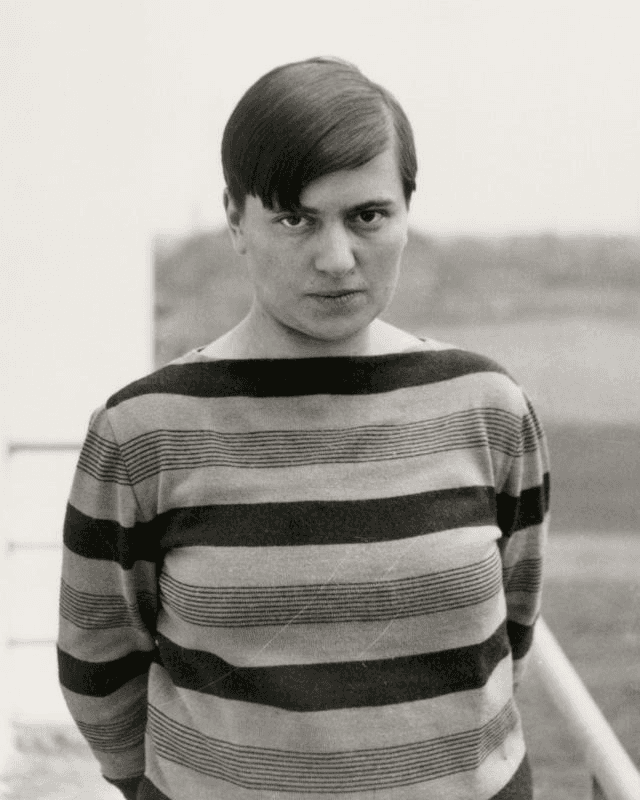
Marianne Brandt. Source: Pamono.de. Retrieved February 19, 2026,
MARIANNE BRAND
A women in male fields
1893 Chemnitz, DE
1983 Kirchberg, DE
Marianne Brandt (née Liebe) was born in Chemnitz in 1893. In 1911, she moved to Weimar, first attending the drawing school and then sign up at the Grand Ducal Saxon Academy of Fine Art, where she received her diploma in 1918. In 1919, she married Eric Brandt; together they traveled and worked as painters in France and Norway over the following two years.
After returning to Weimar, Brandt turned to sculpture. However, a Bauhaus exhibition impressed her so profoundly that she burned her earlier paintings and, in 1924, began studying at the Bauhaus. After completing the preliminary course, László Moholy-Nagy, head of the metal workshop, recommended that she join his workshop—an unusual step for a woman at that time. Despite initial harassment from her male fellow students, she succeeded with her innovative designs.
In 1924, she designed her famous tea infuser, which later achieved the highest auction price ever paid for a Bauhaus object for many years—selling for $361,000 in 2007. After the Bauhaus moved to Dessau, lamps she designed together with Hans Przyrembel were installed in the new buildings.
In 1927, she received a paid position as deputy head of the metal workshop. Following Moholy-Nagy’s departure, she led the workshop until 1929, becoming one of the few women in a leadership position at the Bauhaus. As her abilities continued to be questioned by male colleagues, she voluntarily left the Bauhaus to work as a designer. She remained the only woman to receive a diploma from the metal workshop.
After working for six months in Walter Gropius’s architectural office, she became head of the metalware factory Ruppelwerk in Gotha. With the rise of National Socialism, her creative work—like that of many other avant-garde artists—was severely restricted. She spent the war years and the period of the GDR primarily in her parents’ home in Chemnitz. Between the late 1940s and early 1950s, she taught industrial design at the Dresden Academy of Arts and Crafts and later at the Academy of Applied Arts in Berlin-Weißensee.
It was only in her later years that East Germany began to recognize the significance of the Bauhaus more fully and to properly appreciate her work. Today, some of her designs are once again being produced and are valued worldwide. Marianne Brandt died in Kirchberg in 1983.
MORE