Most important female architect trained at the Bauhaus
1906 Dresden, DE
1964 Bonn, DE
matriculated: 1927
Wera Meyer-Waldeck was born in May 1906 in Dresden. In 1908, her family moved to Egypt, and in 1915 they relocated to Switzerland. In 1921, she returned to Dresden to complete her school education. From 1922 to 1924, she trained as a kindergarten teacher, and by 1927 she had completed studies at the Dresden Academy of Applied Arts. That same year, she matriculated at the Bauhaus in Dessau. She believed that the Bauhaus uniquely offered female students opportunities unavailable elsewhere, granting unrestricted access to a wide range of technical and artistic subjects before specialization. Her interest in both art and technology aligned with the Bauhaus’s original vision under Walter Gropius. However, this vision shifted under Hannes Meyer, who emphasized architecture and engineering, fields largely dominated by men. Despite this, Meyer-Waldeck aspired to join this technical elite.
After completing the woodworking workshop, she received her carpentry certificate in 1931. In 1932, she graduated from the Bauhaus in building planning as an architect. Although highly qualified, she initially struggled to find work as an architect, taking on projects in Dessau related to aircraft construction. In 1937, she moved to Berlin and worked in the planning office for the Reichsautobahnen, designing bridges, rest areas, and office buildings. By 1939, she was employed by the Reichsbaubahnbaudirektion, designing railway stations in Berlin. From 1942 to 1945, she headed the planning and construction office of the Karwin Mining and Metallurgical Company in Oberschlesien.
At the end of World War II, her skills in English and French allowed her to work for an American military base in Mining, Austria. She later returned to Dresden to become a lecturer in interior design at the State Academy of Applied Arts. In 1950, she moved to Bonn and opened her own architecture office, undertaking numerous medium-sized projects. She explored innovative energy-efficient systems, building Bonn’s first Ytong model house in 1951–52 using lightweight aerated concrete. As a board member of the German Women’s Association and president of the Commission for Public Works and Housing, she organized “so…wohnen,” one of the first post-war housing exhibitions in Bonn. Together with Hans Schwippert, she planed the interior design of the new German Bundestag in Bonn. She maintained active engagement in women’s associations and had numerous contacts with female architects, becoming one of the few women in the Bund Deutscher Architekten (BDA).
In 1957, she participated in Interbau in Berlin, designing a courtyard building under the theme “The City of Tomorrow.” Her design included multi-family homes and residential models for diverse family configurations. She warned in her writings about social and physical isolation risks in large housing complexes affecting families, refugees, singles, and the elderly. In 1962, she announced plans to build a major student residence in Bonn-Friesdorf, reflecting her Bauhaus-era principles with flat roofs and large, well-integrated windows. This project was intended as the pinnacle of her career, but she passed away in April 1964 before its completion; the final building was finished by others with significant changes.

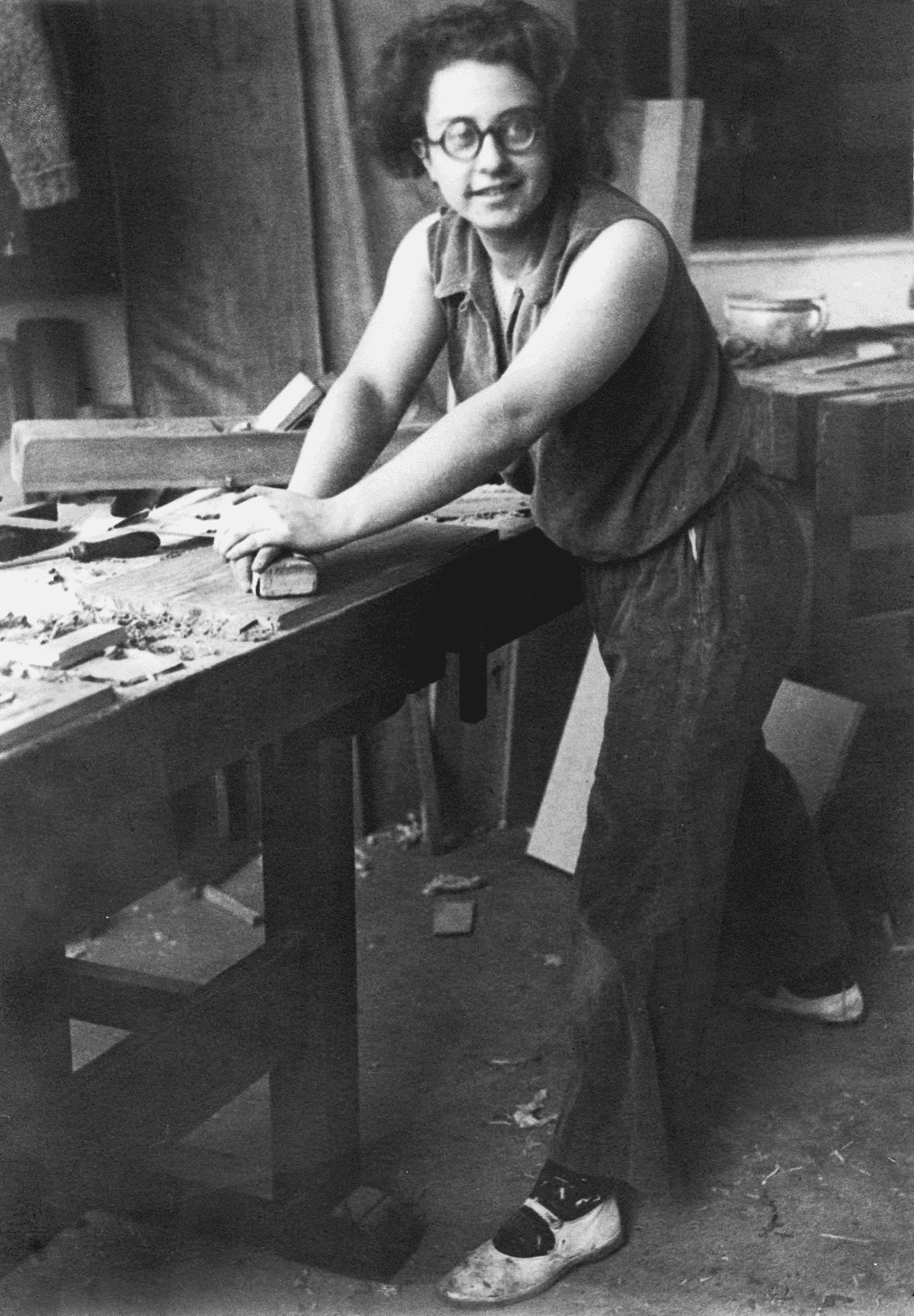
Wera Meyer‑Waldeck. Bron: Barba & Redondo (2019), Metalocus.
WERA MAYER-WALDECK
MORE